
You invest in the shoot. The prop styling. The copywriting. The approvals. And then you post it to your Instagram page, where maybe 10–15% of your followers actually see it — if you’re lucky — before the algorithm buries it. That’s a real problem, and it’s one we’ve been thinking about at Ignite for a long time.
Back in 2016, we trademarked a concept that addresses this problem head-on. We called it Organish®. And if you manage social media for a brand, it’s probably the highest-ROI change you can make to your current approach.
What Is Organish? (And Why Did We Need a New Word?)
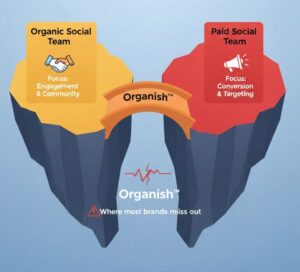 Organish is exactly what it sounds like: it’s organic content that performs well, supplemented with paid distribution. It’s organic-ish. Organic content getting a little paid help. Organish.
We trademarked the term because, frankly, we kept explaining the concept over and over to clients and prospects, and the industry didn’t have a word for it. Now it does.
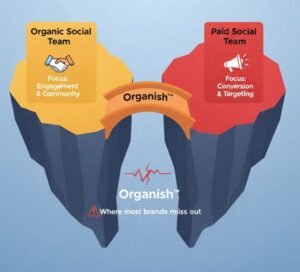
The idea is simple. Most brands treat paid and organic social as two completely separate workstreams. The organic team creates content to build community and engagement. The paid team creates ads to drive conversions. These two groups often don’t even sit next to each other, let alone share assets or strategy. That silo is costing brands money — a lot of it.
Organish bridges that gap. It takes the content you’re already producing — content built to feel native to the platform — and puts modest paid dollars behind it to dramatically extend its reach.
The Math Is Almost Embarrassingly Good
Here’s a quick illustration. Let’s say you have a brand Instagram page with 100,000 followers, which is fairly typical for a mid-size consumer brand. You produce a piece of content — a lifestyle video, a product shot, a creator collab — and it costs you $800 all-in. Time, production, whatever. You post it organically and it reaches about 15,000 impressions. That’s a CPM of roughly $53.
Now you add $1,000 in paid distribution at a $3.00 CPM. Suddenly that same piece of content reaches over 348,000 impressions. Your total spend is $1,800, and your blended CPM drops to $5.17. That’s a 90% reduction in cost per view.
Even if you factor in a generous 15% agency placement commission, you’re still looking at an 88.7% reduction in cost per view. If those numbers don’t make your eyes light up a little, I’d check your pulse.
The reason this works is social’s unique pricing dynamic. Because Organish content is built “social first” — it looks and feels like the content users are already scrolling past rather than a traditional ad — it achieves CPMs far below what standard paid creative commands. We’ve seen this play out with a retail client whose conversion-focused ad content ran at a $12 CPM, while influencer-created Organish content reached their target audience at roughly $2. That’s the Organish effect in action.
But Does It Compete With Paid Social?
I hear this concern regularly, and it’s a fair one to raise. The short answer is no — Organish doesn’t cannibalize your paid social program. It actually supports it.
Think about how buying decisions actually work. Awareness has to come before consideration, and consideration has to come before conversion. Most traditional paid social skips straight to the conversion ask. That can work, but it works a whole lot better when the person seeing your conversion ad already knows who you are and has some affinity for your brand.
Organish content tends to operate earlier in that funnel — it builds awareness and consideration without the aggressive call-to-action. When your audience sees Organish content and then later encounters a conversion-focused ad from the same brand, those two exposures reinforce each other. You’re not competing for attention; you’re constructing a sequence.
It Doesn’t Stop at Social
 Here’s what surprised us, honestly. When clients started taking their Organish content and using it beyond social media, the performance followed.
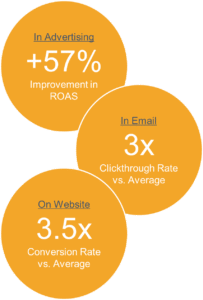
For one retail client who tracked results all the way through to purchase, Organish-style content delivered a 57% improvement in ROAS when used in advertising, more than 3x the average clickthrough rate when embedded in their email program, and a 3.5x improvement in on-site conversion rates compared to their standard creative. The add-to-cart rate was 34.2% for Organish content vs. 19% for everything else.
That last part is worth pausing on. The same content type that performs well on social because it feels authentic and human? That quality translates to email and to your website too. Turns out people respond to content that doesn’t look like an ad regardless of where they encounter it.
This reframes the economics of Organish entirely. You’re not just getting more reach out of your social content — you’re getting a versatile asset that performs across your entire marketing mix. The initial investment gets more valuable at every step.
Why Most Brands Are Still Missing This
If Organish is this effective, why isn’t everyone doing it?
Mostly, I think it comes back to the org chart. When organic social and paid social are managed by different teams with different budgets and different KPIs, nobody has the incentive or authority to bridge them. The organic team is measured on engagement. The paid team is measured on ROAS. Neither team owns the content ecosystem as a whole.
The brands that do this well have — either internally or through an agency — unified the strategic thinking across both. They make content decisions with distribution in mind from the start. They identify what’s performing organically before it’s even finished its organic run and put paid behind it while it still has momentum. And they recycle that content everywhere it makes sense to use it.
It sounds like a small structural change. But the results it produces aren’t small at all.
Getting Started With Organish
You don’t need to overhaul your entire program to try this. Start with one content type on one platform. Identify your top-performing organic posts from the last 90 days — the ones that drove real engagement, not just reach — and put $500–$1,000 in paid distribution behind a new piece of that same content type. Track your blended CPM and compare it to what you’re paying for standard paid creative.
I’d be surprised if you weren’t impressed by what you see.
We’ve been running Organish programs for clients across retail, CPG, finance, travel, and more for nearly a decade now. The results are consistent. The math works. And the brands that commit to it stop thinking about paid and organic social as competing priorities — and start treating content amplification as the integrated strategy it should always have been.
Want to explore whether an Organish approach makes sense for your brand? Get in touch with our team today.
The post Organish®: The Smarter Way to Amplify Your Organic Social Media Content appeared first on Ignite Social Media.